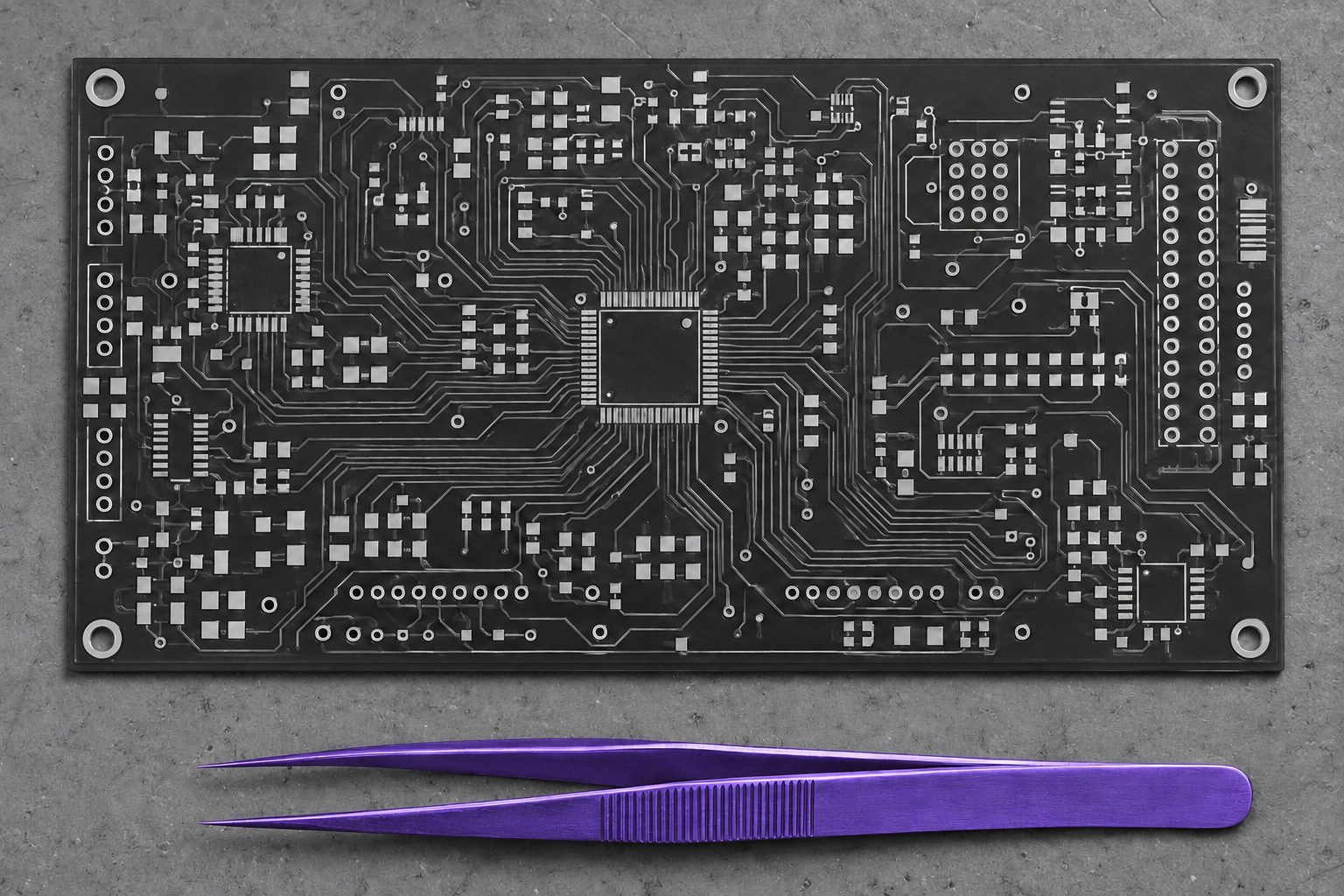
Anthropic’s newly released Claude Fable 5.2 designed three working electronic devices, including a home voice assistant hub, from one-paragraph prompts during pre-release testing. The model wrote its own specifications, selected components, routed four-layer circuit boards, designed 3D printing enclosures and programmed the software, making each board ready for manufacture in under a day with no modifications needed. While Fable 5.2 is available across all paid plans, Anthropic restricted access to its companion model, Claude Mythos 5.2, which removes biology and cybersecurity safeguards, to vetted organizations pursuing beneficial cybersecurity or biomedical research.
Fable 5.2 took the top spot on the Epoch Capabilities Index at 174, passing OpenAI’s GPT-6 Astra at 169, and ranked first on the Artificial Analysis Intelligence Index v5 with a score of 65 at maximum effort, ahead of Google’s Gemini 4 Carbon at 60 and Claude Opus 5.5 at 59. The model also scored 97.7% on ARC-AGI-3 using a provider adapter harness and 81.2% in the standard harness. Despite a 20% token price cut to $8 per million input tokens and $40 per million output tokens, Artificial Analysis noted that running Fable 5.2 at maximum effort averages $26.50 per task, roughly double the $12.99 of Fable 5.1 and 2.6 times the $10 of Opus 5.5.
In other pre-release tests, a team of 1,000 Fable 5.2 agents formalized the proof of Fermat’s Last Theorem in 30 hours, and the model solved two open problems in black hole physics. Meanwhile, Mythos 5.2 accurately modeled 28 of 34 tested capsids, the protein shells used to deliver gene therapies. During training, Anthropic limited advances in accelerator kernel optimization and large language model architecture improvements to Opus 5.5 levels so the models would not directly accelerate AI development.